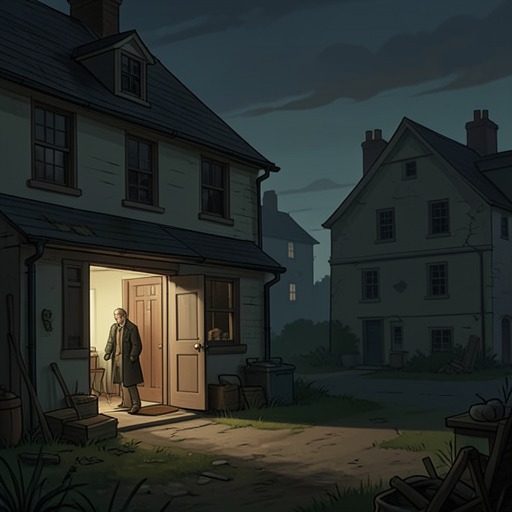
Midge Hardcastle
The HollowMidge Hardcastle is Lucy Angkatell's young cousin and a working woman moving uneasily between the comfort of The Hollow and the humiliations of employment. She enters the story as the person Lucy chooses for immediate consultation about the difficulties of the coming weekend, but her larger significance lies in the contrast she embodies: she belongs to the Angkatell family socially, yet remains separated from its leisured security by the necessity of earning her own living. Her independence is not decorative. It governs her choices, sharpens her resentment, and ultimately enables her to act with exceptional practicality when Edward Angkatell's life is at stake.
Identity and Background
Midge arrives at The Hollow the night before the opening morning, and Lucy Angkatell immediately seeks her out as a trusted young relation. At 6:13 a.m. on Friday, Lucy is already awake, her mind crowded with problems, and mentally conducting the conversation before she enters Midge's room. The scene establishes Midge as part of Lucy's intimate family circle, but also as someone whose presence is useful precisely because she can be consulted: she is close enough to share the household's emotional life while distinct enough to bring another perspective into it.
That distinction is economic as much as personal. Midge works at Madame Alfrege's clothing shop for four pounds a week. She dislikes the shop, Madame Alfrege, and the continual subservience demanded by ill-tempered customers, yet she has no confidence that her qualifications would secure a more agreeable position. Her employment is therefore neither a temporary comic inconvenience nor a sign of youthful irresponsibility. It is the fixed material condition against which she measures the offers and assumptions of her prosperous relations.
Work, Dignity, and Class
Midge refuses to borrow money, use family influence, or accept the easier life that Lucy, Henry Angkatell, and Edward would willingly provide. She recognizes that they could give her a home or an allowance, and that Edward would gladly do so, but something in her resists receiving comfort as a gift. She also declines to start a business with money borrowed from relations and friends, having seen too much of that arrangement to regard it as genuine independence. Her four-pound wage thus carries a moral meaning beyond its amount: it is proof that she has found work for herself without converting kinship into financial leverage.
Her bitterness arises from the gulf she perceives between the leisured and the working. Lucy, Henry, Edward, and even Henrietta Savernake cannot fully understand the difficulty of obtaining a job and then keeping it. Midge does not romanticize labor; she dislikes the shop and knows that Madame Alfrege may have hired her partly in the hope that she would attract fashionable friends, a hope she firmly frustrates by discouraging her acquaintances from shopping there. Her independence is consequently stubborn rather than sentimental. She accepts the unpleasantness of work without pretending that it is liberating, and refuses the privileges that might make her less vulnerable at the cost of compromising the principle she has chosen.
The shop makes the cost of that principle visible. Midge is required to perform deference while customers speak to her with insolence. When Edward Angkatell visits, he hears her responding in a soft, deferential, persuasive voice to a customer who rejects her suggestions and orders her to take more trouble. Her politeness is not evidence of submission in character; it is emotional labor imposed by the job. Midge understands the practical boundary that Edward does not: if she threw the dresses at an abusive customer's head, she would lose her employment. The difference between them is therefore not simply temperament. Edward can imagine revolt because he does not bear its economic consequences; Midge must manage anger as part of the price of survival.
Relationships and Conflict
Edward's concern reveals both his affection for Midge and his limited understanding of her position. After seeing the conditions of the shop for himself, he protests that the treatment is wrong and imagines taking her directly to Ainswick, bundling her into a taxi and removing her from the whole situation. His impulse is protective, but it reproduces the very dependence Midge rejects: he offers rescue through the family world rather than asking what kind of life she has deliberately tried to build outside it.
Midge initially tells Edward not to be upset and asks why he came instead of telephoning, maintaining the nonchalance expected of someone who has learned to contain her feelings at work. His intervention breaks that composure. After a long, tiring morning of difficult customers and Madame Alfrege's bullying, she turns on him with sudden resentment and challenges the offer by asking why he does not simply take her away, since taxis are available. The exchange converts an apparently romantic rescue into a confrontation over agency, money, and the difference between wanting to be saved and wanting one's choices to be respected.
Edward later makes the proposal explicit: he suggests that Midge come to Ainswick for good, if she can put up with him. She responds cautiously, asking what he really means, rather than accepting the promise as an uncomplicated escape. Her restraint is consistent with the rest of her conduct. Midge can enjoy the well-ordered luxury of Lucy's life during occasional visits, but she does not confuse pleasure in that world with willingness to surrender herself to it. The possible future with Edward therefore carries a genuine conflict between intimacy and independence.
Action and Crisis
Midge's practical intelligence becomes decisive when she discovers Edward unconscious in the kitchen, with his head inside a gas oven turned on full. She does not freeze or wait for someone else to interpret the emergency. She throws open the shutters, breaks the window with a glass cloth wrapped around her arm when she cannot unlatch it, pulls Edward from the oven, and switches off the taps. She then drags him toward the window, where the moving air can disperse the fumes, and gathers him into her arms while he remains unconscious and breathes strangely.
The rescue is a concentrated expression of her character. The same person who must calculate the consequences of an impulsive gesture in the clothing shop acts instantly when life is at risk. Her competence is physical, immediate, and unsentimental. It also reverses the expected direction of care between Midge and Edward: he has imagined taking her away from danger and dependence, but in the crisis she is the one who preserves his life. Her independence is not merely a refusal of assistance; it includes the capacity to become the necessary source of assistance for another person.
Narrative Role and Significance
Midge provides the novel with a social and emotional measure by which the Angkatell household's privileges can be tested. Her presence makes visible what the leisured characters can afford to ignore: courtesy may be a commodity sold by workers, employment may depend on enduring humiliation, and a generous offer may still feel like a threat to self-determination. Through her, the family estate is not simply a place of comfort but a place whose comfort has unequal meanings for those who enter it.
She is also a rounded figure because her actions repeatedly complicate first impressions. She can be relaxed enough to enjoy breakfast in bed, a book, and a late morning at The Hollow; she can be “gloriously rude” in anticipation of escaping the shop's restraints; she can feel fierce bitterness toward relatives whose security separates them from her; and she can nevertheless respond to Edward's crisis with disciplined care. These apparently opposed qualities belong together. Midge's irritation, pride, tenderness, and practical courage all arise from the same refusal to let other people define what she owes them or what she is capable of doing.
Her arc does not erase the class gulf or resolve the discomfort of work. Instead, it gives that conflict a personal form. Midge remains caught between the attraction of Ainswick and the dignity of standing on her own, between Edward's wish to protect her and her need to remain the author of her life. The rescue of Edward establishes the strongest evidence against treating her as merely dependent: when the decisive moment arrives, she is not carried out of the world of difficulty. She enters it, understands it, and acts.